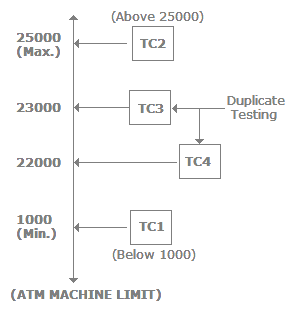
In some projects there are scenarios where we need to do boundary value testing. For instance, let's say for a bank application you can withdraw a maximum of 25000 and a minimum of 100. So in boundary value testing we only test the exact boundaries rather than hitting in the middle. That means we only test above the max and below the max. This covers all scenarios. The following figure shows the boundary value testing for the bank application which we just described. TC1 and TC2 are sufficient to test all conditions for the bank. TC3 and TC4 are just duplicate/redundant test cases which really do not add any value to the testing. So by applying proper boundary value fundamentals we can avoid duplicate test cases, which do not add value to the testing.
Can you explain equivalence partitioning?
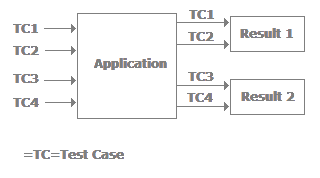
In equivalence partitioning we identify inputs which are treated by the system in the same way and produce the same results. You can see from the following figure applications TC1 and TC2 give the same results (i.e., TC3 and TC4 both give the same result, Result2). In short, we have two redundant test cases. By applying equivalence partitioning we minimize the redundant test cases.
So apply the test below to see if it forms an equivalence class or not:
All the test cases should test the same thing.
They should produce the same results.
If one test case catches a bug, then the other should also catch it.
If one of them does not catch the defect, then the other should not catch it.
Can you explain random/monkey testing?
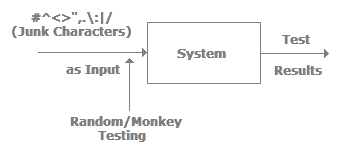
Random testing is sometimes called monkey testing. In Random testing, data is generated randomly often using a tool. For instance, the following figure shows how randomly-generated data is sent to the system. This data is generated either using a tool or some automated mechanism. With this randomly generated input the system is then tested and results are observed accordingly.
Random testing has the following weakness:
They are not realistic.
Many of the tests are redundant and unrealistic.
You will spend more time analyzing results.
You cannot recreate the test if you do not record what data was used for testing.
Six Sigma is a statistical measure of variation in a process. We say a process has achieved Six Sigma if the quality is 3.4 DPMO (Defect per Million Opportunities). It's a problem-solving methodology that can be applied to a process to eliminate the root cause of defects and costs associated with it.
Can you explain the different methodology for the execution and the design process stages in Six Sigma?
The main focus of Six Sigma is to reduce defects and variations in the processes. DMAIC and DMADV are the models used in most Six Sigma initiatives.
DMADV is the model for designing processes while DMAIC is used for improving the process.
The DMADV model includes the following five steps:
Define: Determine the project goals and the requirements of customers (external and internal).
Measure: Assess customer needs and specifications.
Analyze: Examine process options to meet customer requirements.
Design: Develop the process to meet the customer requirements.
Verify: Check the design to ensure that it's meeting customer requirements
The DMAIC model includes the following five steps:
Define the projects, goals, and deliverables to customers (internal and external). Describe and quantify both the defects and the expected improvements.
Measure the current performance of the process. Validate data to make sure it is credible and set the baselines.
Analyze and determine the root cause(s) of the defects. Narrow the causal factors to the vital few.
Improve the process to eliminate defects. Optimize the vital few and their interrelationships.
Control the performance of the process. Lock down the gains.
Can you explain the fish bone/Ishikawa diagram?
There are situations where we need to analyze what caused the failure or problem in a project. The fish bone or Ishikawa diagram is one important concept which can help you find the root cause of the problem. Fish bone was conceptualized by Ishikawa, so in honor of its inventor, this concept was named the Ishikawa diagram. Inputs to conduct a fish bone diagram come from discussion and brainstorming with people involved in the project. The following figure shows the structure of the Ishikawa diagram.
The main bone is the problem which we need to address to know what caused the failure. For instance, the following fish bone is constructed to find what caused the project failure. To know this cause we have taken four main bones as inputs: Finance, Process, People, and Tools.
What is CMMI and what's the advantage of implementing it in an organization?
CMMI stands for Capability Maturity Model Integration. It is a process improvement approach that provides companies with the essential elements of an effective process. CMMI can serve as a good guide for process improvement across a project, organization, or division.
CMMI was formed by using multiple previous CMM processes.
The following are the areas which CMMI addresses:
Systems engineering: This covers development of total systems. System engineers concentrate on converting customer needs to product solutions and supports them throughout the product lifecycle.
Software engineering: Software engineers concentrate on the application of systematic, disciplined, and quantifiable approaches to the development, operation, and maintenance of software.
Integrated Product and Process Development (IPPD): Integrated Product and Process Development (IPPD) is a systematic approach that achieves a timely collaboration of relevant stakeholders throughout the life of the product to better satisfy customer needs, expectations, and requirements. This section mostly concentrates on the integration part of the project for different processes. For instance, it's possible that your project is using services of some other third party component. In such situations the integration is a big task itself, and if approached in a systematic manner, can be handled with ease.
Software acquisition: Many times an organization has to acquire products from other organizations. Acquisition is itself a big step for any organization and if not handled in a proper manner means a disaster is sure to happen.
What's the difference between implementation and institutionalization?
Both of these concepts are important while implementing a process in any organization. Any new process implemented has to go through these two phases.
Implementation: It is just performing a task within a process area. A task is performed according to a process but actions performed to complete the process are not ingrained in the organization. That means the process involved is done according to the individual point of view. When an organization starts to implement any process it first starts at this phase, i.e., implementation, and then when this process looks good it is raised to the organization level so that it can be implemented across organizations.
Institutionalization: Institutionalization is the output of implementing the process again and again. The difference between implementation and institutionalization is in implementation if the person who implemented the process leaves the company the process is not followed, but if the process is institutionalized then even if the person leaves the organization, the process is still followed.
Can you explain the different maturity levels in a staged representation?
There are five maturity levels in a staged representation as shown in the following figure.
Maturity Level 1 (Initial): In this level everything is adhoc. Development is completely chaotic with budget and schedules often exceeded. In this scenario we can never predict quality.
Maturity Level 2 (Managed): In the managed level basic project management is in place. But the basic project management and practices are followed only in the project level.
Maturity Level 3 (Defined): To reach this level the organization should have already achieved level 2. In the previous level the good practices and process were only done at the project level. But in this level all these good practices and processes are brought to the organization level. There are set and standard practices defined at the organization level which every project should follow. Maturity Level 3 moves ahead with defining a strong, meaningful, organizational approach to developing products. An important distinction between Maturity Levels 2 and 3 is that at Level 3, processes are described in more detail and more rigorously than at Level 2 and are at an organization level.
Maturity Level 4 (Quantitatively measured): To start with, this level of organization should have already achieved Level 2 and Level 3. In this level, more statistics come into the picture. Organization controls the project by statistical and other quantitative techniques. Product quality, process performance, and service quality are understood in statistical terms and are managed throughout the life of the processes. Maturity Level 4 concentrates on using metrics to make decisions and to truly measure whether progress is happening and the product is becoming better. The main difference between Levels 3 and 4 are that at Level 3, processes are qualitatively predictable. At Level 4, processes are quantitatively predictable. Level 4 addresses causes of process variation and takes corrective action.
Maturity Level 5 (Optimized): The organization has achieved goals of maturity levels 2, 3, and 4. In this level, processes are continually improved based on an understanding of common causes of variation within the processes. This is like the final level; everyone on the team is a productive member, defects are minimized, and products are delivered on time and within the budget boundary.
The following figure shows, in detail, all the maturity levels in a pictorial fashion.
Can you explain the PDCA cycle and where testing fits in?
Software testing is an important part of the software development process. In normal software development there are four important steps, also referred to, in short, as the PDCA (Plan, Do, Check, Act) cycle.
Let's review the four steps in detail.
Plan: Define the goal and the plan for achieving that goal.
Do/Execute: Depending on the plan strategy decided during the plan stage we do execution accordingly in this phase.
Check: Check/Test to ensure that we are moving according to plan and are getting the desired results.
Act: During the check cycle, if any issues are there, then we take appropriate action accordingly and revise our plan again.
So developers and other stakeholders of the project do the "planning and building," while testers do the check part of the cycle. Therefore, software testing is done in check part of the PDCA cyle.
What is the difference between white box, black box, and gray box testing?
Black boxtesting is a testing strategy based solely on requirements and specifications. Black box testing requires no knowledge of internal paths, structures, or implementation of the software being tested.
White box testing is a testing strategy based on internal paths, code structures, and implementation of the software being tested. White box testing generally requires detailed programming skills.
There is one more type of testing called gray box testing. In this we look into the "box" being tested just long enough to understand how it has been implemented. Then we close up the box and use our knowledge to choose more effective black box tests.
The above figure shows how both types of testers view an accounting application during testing. Black box testers view the basic accounting application. While during white box testing the tester knows the internal structure of the application. In most scenarios white box testing is done by developers as they know the internals of the application. In black box testing we check the overall functionality of the application while in white box testing we do code reviews, view the architecture, remove bad code practices, and do component level testing.
Can you explain usability testing?
Usability testing is a testing methodology where the end customer is asked to use the software to see if the product is easy to use, to see the customer's perception and task time. The best way to finalize the customer point of view for usability is by using prototype or mock-up software during the initial stages. By giving the customer the prototype before the development start-up we confirm that we are not missing anything from the user point of view.
What are the categories of defects?
There are three main categories of defects:
Wrong: The requirements have been implemented incorrectly. This defect is a variance from the given specification.
Missing: There was a requirement given by the customer and it was not done. This is a variance from the specifications, an indication that a specification was not implemented, or a requirement of the customer was not noted properly.
Extra: A requirement incorporated into the product that was not given by the end customer. This is always a variance from the specification, but may be an attribute desired by the user of the product. However, it is considered a defect because it's a variance from the existing requirements.
It is a useful, memory-saving technique for multiprogrammed timesharing systems. A Reentrant Procedure is one in which multiple users can share a single copy of a program during the same period. Reentrancy has 2 key aspects: The program code cannot modify itself, and the local data for each user process must be stored separately. Thus, the permanent part is the code, and the temporary part is the pointer back to the calling program and local variables used by that program. Each execution instance is called activation. It executes the code in the permanent part, but has its own copy of local variables/parameters. The temporary part associated with each activation is the activation record. Generally, the activation record is kept on the stack.
Note: A reentrant procedure can be interrupted and called by an interrupting program, and still execute correctly on returning to the procedure.
Explain Belady's Anomaly?
Also called FIFO anomaly. Usually, on increasing the number of frames allocated to a process virtual memory, the process execution is faster, because fewer page faults occur. Sometimes, the reverse happens, i.e., the execution time increases even when more frames are allocated to the process. This is Belady's Anomaly. This is true for certain page reference patterns.
What is a binary semaphore? What is its use?
A binary semaphore is one, which takes only 0 and 1 as values. They are used to implement mutual exclusion and synchronize concurrent processes.
What is thrashing?
It is a phenomenon in virtual memory schemes when the processor spends most of its time swapping pages, rather than executing instructions. This is due to an inordinate number of page faults.
What are the basic functions for master, msdb, model, tempdb and resource databases?
The master database holds information for all databases located on the SQL Server instance and is theglue that holds the engine together. Because SQL Server cannot start without a functioning masterdatabase, you must administer this database with care.
The msdb database stores information regarding database backups, SQL Agent information, DTS packages, SQL Server jobs, and some replication information such as for log shipping.
The tempdb holds temporary objects such as global and local temporary tables and stored procedures.
The model is essentially a template database used in the creation of any new user database created in the instance.
The resoure Database is a read-only database that contains all the system objects that are included with SQL Server. SQL Server system objects, such as sys.objects, are physically persisted in the Resource database, but they logically appear in the sys schema of every database. The Resource database does not contain user data or user metadata.
What is Service Broker?
Service Broker is a message-queuing technology in SQL Server that allows developers to integrate SQL Server fully into distributed applications. Service Broker is feature which provides facility to SQL Server to send an asynchronous, transactional message. it allows a database to send a message to another database without waiting for the response, so the application will continue to function if the remote database is temporarily unavailable.
Where SQL server user names and passwords are stored in SQL server?
They get stored in System Catalog Views sys.server_principals and sys.sql_logins.
What is Policy Management?
Policy Management in SQL SERVER 2008 allows you to define and enforce policies for configuring and managing SQL Server across the enterprise. Policy-Based Management is configured in SQL Server Management Studio (SSMS). Navigate to the Object Explorer and expand the Management node and the Policy Management node; you will see the Policies, Conditions, and Facets nodes.
1.The total of the ages of Amar, Akbar and Anthony is 80 years. What was the total of their ages three years ago ?
71 years
72 years
74 years
77 years
2. Two bus tickets from city A to B and three tickets from city A to C cost Rs. 77 but three tickets from city A to B and two tickets from city A to C cost Rs. 73. What are the fares for cities B and C from A ?
3.An institute organised a fete and 1/5 of the girls and 1/8 of the boys participated in the same. What fraction of the total number of students took part in the fete ?
2/13
13/40
Data inadequate
None of these
4.A number of friends decided to go on a picnic and planned to spend Rs. 96 on eatables. Four of them, however, did not turn up. As a consequence, the remaining ones had to contribute Rs. 4 each extra. The number of those who attended the picnic was
8
12
16
24
5.A, B, C, D and E play a game of cards. A says to B, "If you give me three cards, you will have as many as E has and if I give you three cards, you will have as many as D has." A and B together have 10 cards more than what D and E together have. If B has two cards more than what C has and the total number of cards be 133, how many cards does B have ?
1. One morning Udai and Vishal were talking to each other face to face at a crossing. If Vishal's shadow was exactly to the left of Udai, which direction was Udai facing?
East
West
North
South
2.Y is in the East of X which is in the North of Z. If P is in the South of Z, then in which direction of Y, is P?
North
South
South-East
None of these
3. If South-East becomes North, North-East becomes West and so on. What will West become?
North-East
North-West
South-East
South-West
4.A man walks 5 km toward south and then turns to the right. After walking 3 km he turns to the left and walks 5 km. Now in which direction is he from the starting place?
West
South
North-East
South-West
5.Rahul put his timepiece on the table in such a way that at 6 P.M. hour hand points to North. In which direction the minute hand will point at 9.15 P.M. ?
1.Vincent has a paper route. Each morning, he delivers 37 newspapers to customers in his neighborhood. It takes Vincent 50 minutes to deliver all the papers. If Vincent is sick or has other plans, his friend Thomas, who lives on the same street, will sometimes deliver the papers for him.
Vincent and Thomas live in the same neighborhood
It takes Thomas more than 50 minutes to deliver the papers
It is dark outside when Vincent begins his deliveries.
Thomas would like to have his own paper route.
2.The Pacific yew is an evergreen tree that grows in the Pacific Northwest. The Pacific yew has a fleshy, poisonous fruit. Recently, taxol, a substance found in the bark of the Pacific yew, was discovered to be a promising new anticancer drug.
Taxol is poisonous when taken by healthy people.
Taxol has cured people from various diseases.
People should not eat the fruit of the Pacific yew.
The Pacific yew was considered worthless until taxol was discovered.
3.Erin is twelve years old. For three years, she has been asking her parents for a dog. Her parents have told her that they believe a dog would not be happy in an apartment, but they have given her permission to have a bird. Erin has not yet decided what kind of bird she would like to have.
Erin's parents like birds better than they like dogs.
Erin does not like birds.
Erin and her parents live in an apartment.
Erin and her parents would like to move.
4.Tim's commute never bothered him because there were always seats available on the train and he was able to spend his 40 minutes comfortably reading the newspaper or catching up on paperwork. Ever since the train schedule changed, the train has been extremely crowded, and by the time the doors open at his station, there isn't a seat to be found.
Tim would be better off taking the bus to work.
Tim's commute is less comfortable since the train schedule changed.
Many commuters will complain about the new train schedule.
Tim will likely look for a new job closer to home.
5.When they heard news of the hurricane, Maya and Julian decided to change their vacation plans. Instead of traveling to the island beach resort, they booked a room at a fancy new spa in the mountains. Their plans were a bit more expensive, but they'd heard wonderful things about the spa and they were relieved to find availability on such short notice.
Maya and Julian take beach vacations every year.
The spa is overpriced.
It is usually necessary to book at least six months in advance at the spa.
Maya and Julian decided to change their vacation plans because of the hurricane.
1.Vincent has a paper route. Each morning, he delivers 37 newspapers to customers in his neighborhood. It takes Vincent 50 minutes to deliver all the papers. If Vincent is sick or has other plans, his friend Thomas, who lives on the same street, will sometimes deliver the papers for him.
Vincent and Thomas live in the same neighborhood.
It takes Thomas more than 50 minutes to deliver the papers.
It is dark outside when Vincent begins his deliveries.
Thomas would like to have his own paper route.
2.The Pacific yew is an evergreen tree that grows in the Pacific Northwest. The Pacific yew has a fleshy, poisonous fruit. Recently, taxol, a substance found in the bark of the Pacific yew, was discovered to be a promising new anticancer drug.
Taxol is poisonous when taken by healthy people.
Taxol has cured people from various diseases.
People should not eat the fruit of the Pacific yew.
The Pacific yew was considered worthless until taxol was discovered.
3.Erin is twelve years old. For three years, she has been asking her parents for a dog. Her parents have told her that they believe a dog would not be happy in an apartment, but they have given her permission to have a bird. Erin has not yet decided what kind of bird she would like to have.
Erin's parents like birds better than they like dogs.
Erin does not like birds.
Erin and her parents live in an apartment
Erin and her parents would like to move.
4.Tim's commute never bothered him because there were always seats available on the train and he was able to spend his 40 minutes comfortably reading the newspaper or catching up on paperwork. Ever since the train schedule changed, the train has been extremely crowded, and by the time the doors open at his station, there isn't a seat to be found.
Tim would be better off taking the bus to work.
Tim's commute is less comfortable since the train schedule changed.
Many commuters will complain about the new train schedule.
Tim will likely look for a new job closer to home
5.When they heard news of the hurricane, Maya and Julian decided to change their vacation plans. Instead of traveling to the island beach resort, they booked a room at a fancy new spa in the mountains. Their plans were a bit more expensive, but they'd heard wonderful things about the spa and they were relieved to find availability on such short notice.
Maya and Julian take beach vacations every year.
The spa is overpriced.
It is usually necessary to book at least six months in advance at the spa.
Maya and Julian decided to change their vacation plans because of the hurricane.
In questions given below, a part of the sentence is italicised and underlined. Below are given alternatives to the italicised part which may improve the sentence. Choose the correct alternative. In case no improvement is needed, option 'D' is the answer.
1.John had told me that he hasn't done it yet.
told
tells
was telling
No improvement
2.If he had time he will call you.
would have
would have had
has
No improvement
3.Will you lend me few rupees in this hour of need?
lend me any rupees
borrow me a few rupees
lend me a few rupees
No improvement
4.During his long discourse, he did not touch that point.
touch upon
touch on
touch of
No improvement
5.He found a wooden broken chair in the room.
wooden and broken chair
broken wooden chair
broken and wooden chair
No improvement